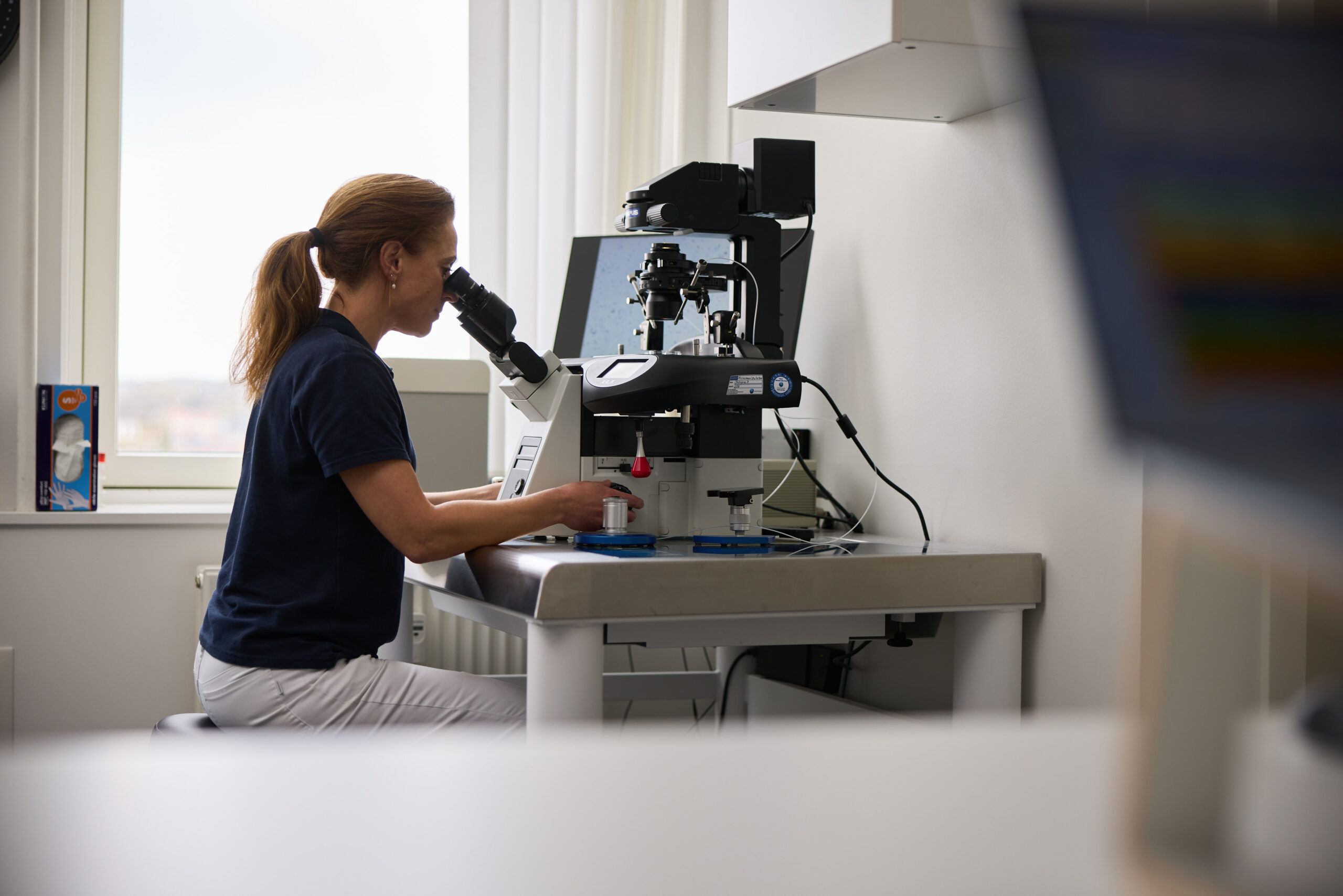
Embryologist looking into a microscope in Diers Fertility Clinic's laboratory

Come with us into the laboratory

Once the eggs have been retrieved, an important part of the IVF treatment begins behind the doors of our laboratory.

In the laboratory, we place great emphasis on professional expertise, precision, and creating conditions that are as stable and gentle as possible.

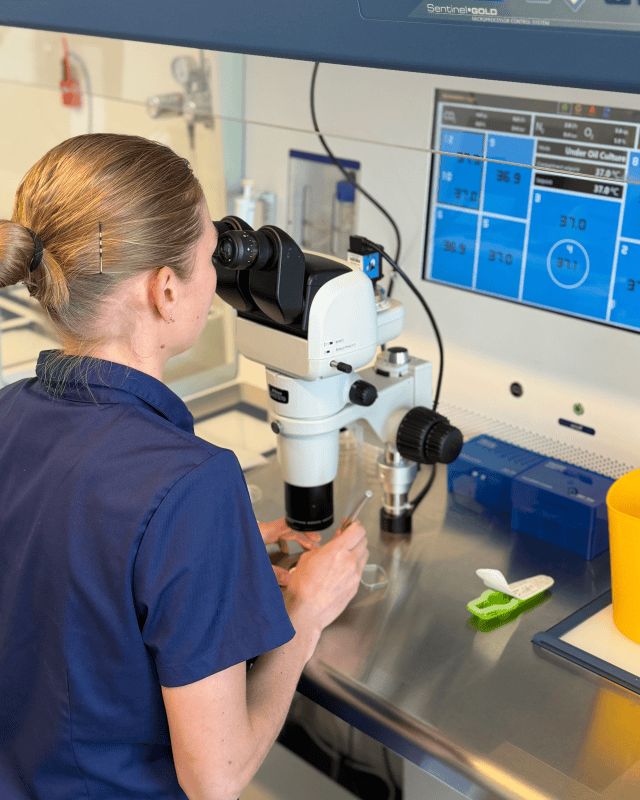
Julie kigger på æg i IVF lab

We take good care of what matters most

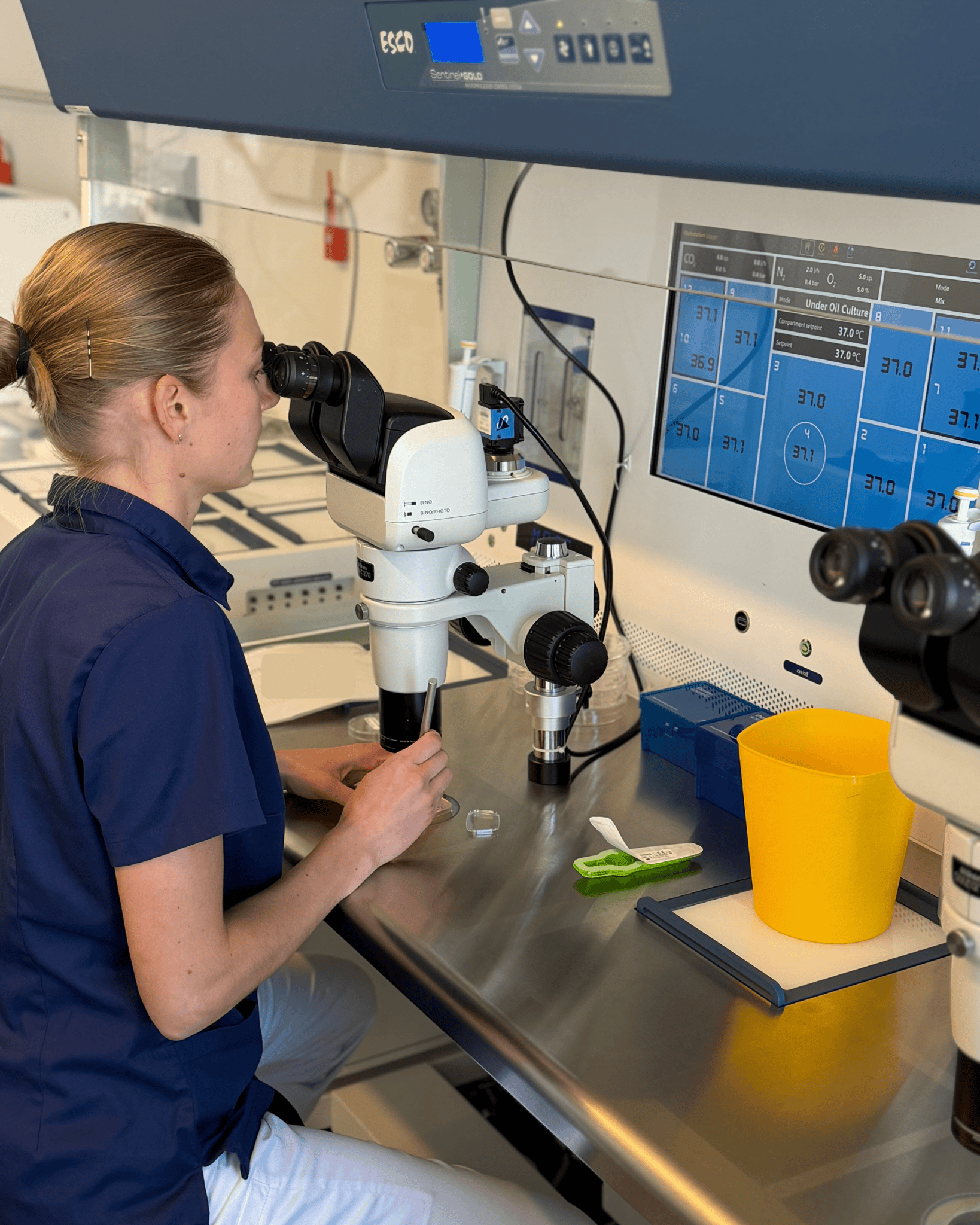
Eggs and embryos are sensitive to changes in their surroundings. That is why we pay close attention to maintaining stable conditions in the laboratory – including temperature, air quality and the culture conditions in which eggs and embryos develop.

At the same time, our embryologists carefully monitor their development. From fertilisation and the first cell divisions to the decision about which embryo to transfer and which embryos may be suitable for freezing.

Most of this work takes place behind the scenes, without you seeing it directly as a patient. But in the laboratory, there is always someone carefully looking after your eggs and embryos.

EmbryoScope+ – a window into embryo development

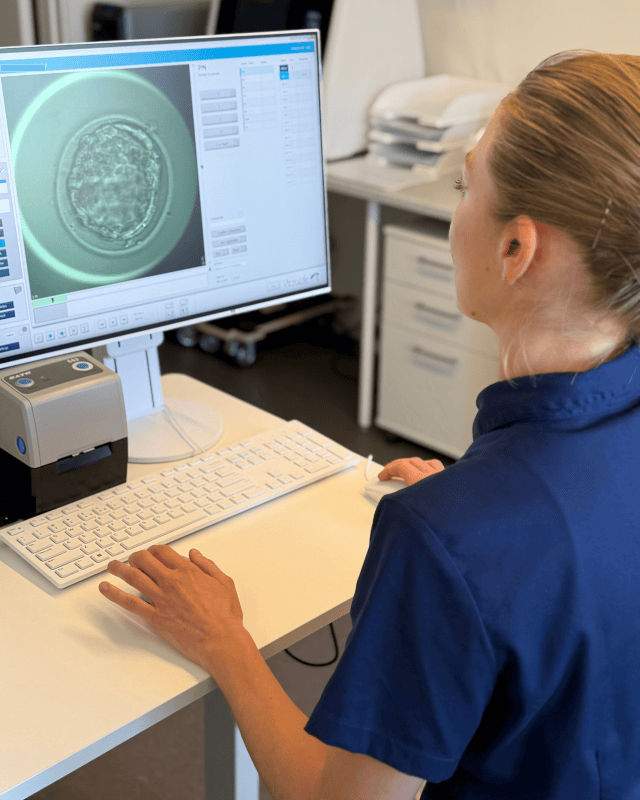
In our laboratory, we use EmbryoScope+, among other technologies. EmbryoScope+ is a modern incubator with an integrated microscope and camera system.

The embryos can develop under controlled conditions while the system takes images at regular intervals. These images are combined into a time-lapse sequence, allowing our embryologists to follow embryo development over a longer period of time.

This means that cell divisions and certain developmental patterns can be observed without routinely removing the embryos from the incubator for each individual assessment.

For our embryologists, this provides additional information about the developmental process and supports their assessment of the embryos.

For you as a patient, this means:

  • Your embryos can remain as stable and undisturbed as possible in the incubator throughout the culture period.

  • The development of your embryos is closely and carefully monitored by our embryologists.

  • Embryo selection is based on additional information about how the embryo has developed over time.

Befrugtet æg på computer

The embryologist remains essential

We know that this part of the treatment can feel both vulnerable and very important to you.

EmbryoScope+ is one of the ways we take particularly good care of your embryos while doing our best to create the best possible conditions for their development.

The technology provides us with additional information, but it does not replace the professional assessment of our embryologists.

Our embryologists continuously assess fertilisation of the eggs and the development of the embryos, bringing together all the information from the laboratory when decisions need to be made about embryo transfer or freezing.

Every treatment journey is individual. Our approach is therefore always based on the specific eggs and embryos we are working with in each treatment cycle.

Julie kigger på æg i mikroskop i lab

Additional options in the laboratory

A good IVF treatment does not automatically require as many additional treatments as possible.

There are, however, different laboratory methods and so-called add-ons that may be relevant in certain situations. At our clinic, EmbryoGlue and calcium ionophore can be added to your treatment.

We do not routinely recommend add-ons to every patient. If we believe that an additional method may be relevant in your individual treatment journey, we will discuss the options with you.

EmbryoGlue

EmbryoGlue is the name of a special transfer medium in which the embryo is placed immediately before embryo transfer.

The medium contains a higher concentration of hyaluronan. This substance also occurs naturally in the body and in the environment surrounding the embryo and the lining of the uterus.

EmbryoGlue is intended to support the conditions around embryo transfer. However, scientific evidence does not clearly show that EmbryoGlue increases the chance of pregnancy or live birth for all patients.

We therefore consider EmbryoGlue to be an optional add-on rather than a necessary part of IVF treatment.

Learn more about EmbryoGlue

Calcium ionophore

For an egg to continue developing after fertilisation, a number of natural activation processes need to take place within the egg.

In some patients, these signalling mechanisms may be less effective. In selected situations, an egg can be briefly treated with calcium ionophore in an attempt to support these natural activation processes.

This method is not suitable for everyone and is not used routinely. It may, for example, be considered if a previous ICSI treatment resulted in no fertilisation or a very low fertilisation rate.

If calcium ionophore may be relevant for your treatment, we will discuss this with you beforehand.

Learn more about Calcium ionophore

What makes sense for you?

When it comes to laboratory treatment, more is not automatically better.

Our aim is to choose the treatment and laboratory methods that are appropriate for your individual journey – and to explain clearly why we recommend a particular approach.

If you have any questions about EmbryoScope+, EmbryoGlue, calcium ionophore or any other aspect of your laboratory treatment, you are always very welcome to contact us: